Agentic AI has quickly moved beyond experimentation. Across industries, organisations are deploying AI agents to automate workflows, coordinate business processes, analyse data, and support decision-making with minimal human intervention.
Yet one question continues to delay adoption:
Should you build your own AI agents, buy an off-the-shelf platform, or orchestrate multiple AI services into a unified ecosystem?
For many IT leaders, CIOs, CTOs, Heads of Digital Transformation, and AI decision-makers, this isn’t simply a technology choice – it’s a strategic business decision.
The market is crowded with AI vendors promising “complete agentic platforms,” open-source frameworks evolve almost weekly, and implementation cycles often stretch far longer than expected.
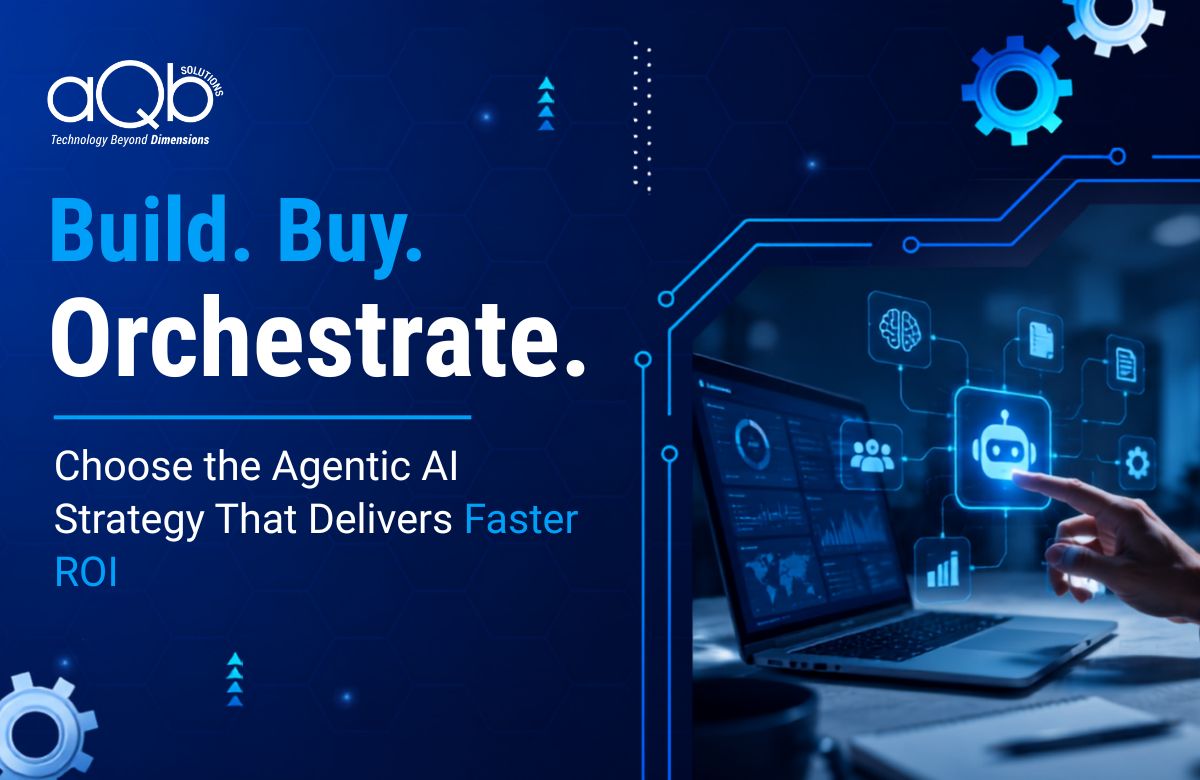
This article explores the Build vs Buy vs Orchestrate decision framework to help enterprises select the right Agentic AI strategy based on business goals, technical maturity, budget, and long-term scalability.
Why This Decision Matters More Than Ever
Unlike traditional automation, Agentic AI combines reasoning, planning, memory, tool usage, and autonomous execution. Modern AI agents don’t simply answer questions, they can:
- Analyse enterprise data
- Coordinate multiple applications
- Trigger workflows
- Make recommendations
- Collaborate with other AI agents
- Continuously improve task execution
As organisations expand AI adoption, they face three common challenges:
- Vendor overload with hundreds of AI products entering the market
- Confusing architectural choices between proprietary and open ecosystems
- Long implementation timelines caused by integration complexity
Choosing the wrong strategy can lead to expensive rework, fragmented systems, vendor lock-in, or AI projects that never move beyond pilot stages.
Option 1: Build Your Own Agentic AI Platform
Building an Agentic AI platform means creating the entire AI ecosystem from scratch. Your organisation designs and develops the core architecture, selects and fine-tunes models, builds orchestration logic, creates memory systems, integrates tools, and manages governance internally.
In this model, the enterprise is responsible for everything – from infrastructure and security to monitoring, maintenance, and continuous model updates.
What building involves
- Developing custom AI agents and workflows
- Designing orchestration and decision-making logic
- Creating memory and context-management systems
- Integrating enterprise applications and APIs
- Implementing security, governance, and compliance controls
- Maintaining and upgrading the platform over time
Best suited for
- Large enterprises with mature AI engineering teams
- Technology companies where AI is a core product or competitive advantage
- Organisations handling highly sensitive or regulated data
- Businesses requiring complete ownership of intellectual property
The cost factor: why building is often too expensive
While building offers maximum control, it is also the most expensive and resource-intensive option.
Enterprises must invest in:
- AI engineers, data scientists, and MLOps specialists
- Cloud infrastructure and computing power
- Custom development and testing
- Security and compliance frameworks
- Ongoing maintenance and model retraining
- Continuous upgrades as AI technologies evolve
For many organisations, these costs can quickly escalate into millions of dollars or pounds, especially when projects require multiple AI agents, complex integrations, and enterprise-grade governance.
In addition to the financial burden, building from scratch often results in long implementation cycles – sometimes taking 12-24 months before meaningful business value is realised.
Advantages
- Complete ownership of the platform and IP
- Maximum customisation and flexibility
- Strong control over data governance
- Ability to create highly specialised AI capabilities
Challenges
- Very high upfront and ongoing costs
- Long development and deployment timelines
- Need for specialised AI talent
- High maintenance burden as AI models and frameworks evolve
- Risk of over-engineering before proving business value
In short: Building is ideal when AI is a strategic differentiator, but for many enterprises, it is simply too costly and too slow to justify as the first step.
Option 2: Buy an Agentic AI Platform
Many software vendors now offer enterprise-ready Agentic AI platforms with pre-built capabilities.
These typically include:
- Workflow automation
- AI copilots
- Knowledge assistants
- Multi-agent coordination
- Pre-built integrations
- Security controls
- Monitoring dashboards
Best suited for
- Mid-sized organisations
- Businesses seeking rapid deployment
- Teams without extensive AI expertise
- Departments looking for quick productivity improvements
Advantages
- Faster implementation
- Lower upfront investment
- Vendor-managed infrastructure
- Built-in updates
- Easier onboarding
Challenges
- Limited customisation
- Vendor lock-in
- Licensing costs increase over time
- Restricted workflow flexibility
- Integration limitations
Buying works well when standard capabilities solve standard business problems.
However, every enterprise eventually develops unique workflows that commercial platforms may struggle to accommodate.
Option 3: Orchestrate Multiple AI Services
Orchestrating Agentic AI is fundamentally different from building from scratch.
Instead of creating every component internally, orchestration means connecting and coordinating existing AI models, enterprise applications, APIs, data sources, and automation tools through a central orchestration layer.
The organisation does not build the entire AI platform. Rather, it builds the control layer that allows different AI services and business systems to work together seamlessly.
What orchestration involves
- Integrating existing enterprise systems such as ERP, CRM, and databases
- Connecting multiple AI models and specialised agents
- Managing workflow execution across systems
- Sharing context and memory between agents
- Applying governance and monitoring centrally
- Allowing components to be replaced or upgraded without rebuilding the whole system
Best suited for
- Enterprises with existing digital infrastructure
- Organisations modernising legacy systems
- Businesses scaling AI across multiple departments
- Companies seeking flexibility without the cost of full custom development
Advantages
- Reuses existing technology investments
- Reduces dependency on a single vendor
- Lower cost than building from scratch
- Faster time-to-value through incremental deployment
- Flexible architecture that can adapt to new AI models
- Scales AI across departments without replacing existing systems
Challenges
- Requires strong integration and architecture planning
- Governance becomes critical as more services are connected
- Monitoring multiple AI components can be complex
- Poor orchestration design can create fragmented workflows
Questions Every Enterprise Should Ask
Before selecting an Agentic AI strategy, decision-makers should evaluate several key factors.
1. What problem are you solving?
Avoid implementing AI simply because competitors are doing so.
Instead, identify measurable business outcomes such as:
- Reducing operational costs
- Improving customer service
- Accelerating software development
- Automating compliance
- Enhancing employee productivity
Business goals should drive architecture, not the other way around.
2. How unique are your workflows?
If your processes closely resemble industry standards, purchasing an enterprise platform may be sufficient.
If your workflows involve proprietary knowledge, complex approvals, or specialised business logic, orchestration or custom development often delivers greater long-term value.
3. How quickly do you need results?
Some organisations require visible ROI within a few months.
Others can invest in multi-year AI transformation programmes.
Time-to-value significantly influences whether buying or building makes more strategic sense.
4. What internal AI capabilities already exist?
Many organisations underestimate existing assets, including:
- APIs
- Data warehouses
- ERP systems
- CRM platforms
- Process automation tools
- Analytics environments
AI orchestration frequently unlocks greater value by connecting these investments rather than replacing them.
5. How important is future flexibility?
Agentic AI is evolving rapidly.
Today’s leading model may not remain the best option next year.
Choosing architectures that allow models and services to be swapped without rebuilding entire systems can significantly reduce long-term costs.
Why AI Orchestration Is Gaining Momentum
Many enterprise AI strategies are shifting from “one platform does everything” to composable AI architectures.
Instead of relying on a single vendor, organisations combine best-of-breed technologies while maintaining central governance.
This enables businesses to:
- Adopt new AI models without major redesign
- Integrate legacy systems
- Reduce implementation risk
- Scale AI incrementally
- Maintain stronger control over enterprise data
Rather than replacing existing infrastructure, orchestration extends its value.
A Practical Decision Framework
Use the following guidance as a starting point:
Build if:
- AI is central to your competitive advantage.
- You have experienced AI engineering teams.
- You require complete architectural control.
Buy if:
- Speed is your highest priority.
- Your use cases are relatively standard.
- You have limited AI development resources.
Orchestrate if:
- You want flexibility without rebuilding everything.
- Multiple business systems must work together.
- You plan to scale AI across the organisation over time.
Many successful enterprises ultimately combine all three approaches. They may buy foundational capabilities, build strategic differentiators, and orchestrate everything into a unified AI ecosystem.
Wrapping Up
There is no universally correct answer to the Build vs Buy vs Orchestrate debate.
The right decision depends on your business objectives, existing technology landscape, governance requirements, internal capabilities, and long-term AI strategy.
What matters most is avoiding architecture decisions driven by hype or vendor marketing.
Agentic AI should accelerate business outcomes, not create additional complexity.
For organisations navigating vendor overload, architectural uncertainty, and lengthy implementation cycles, an orchestration-first approach often provides the most practical path. It enables businesses to modernise at their own pace, leverage existing investments, and remain adaptable as AI technologies continue to evolve.
As Agentic AI becomes a core component of enterprise operations, organisations that make thoughtful architectural decisions today will be better positioned to innovate, scale, and compete tomorrow.