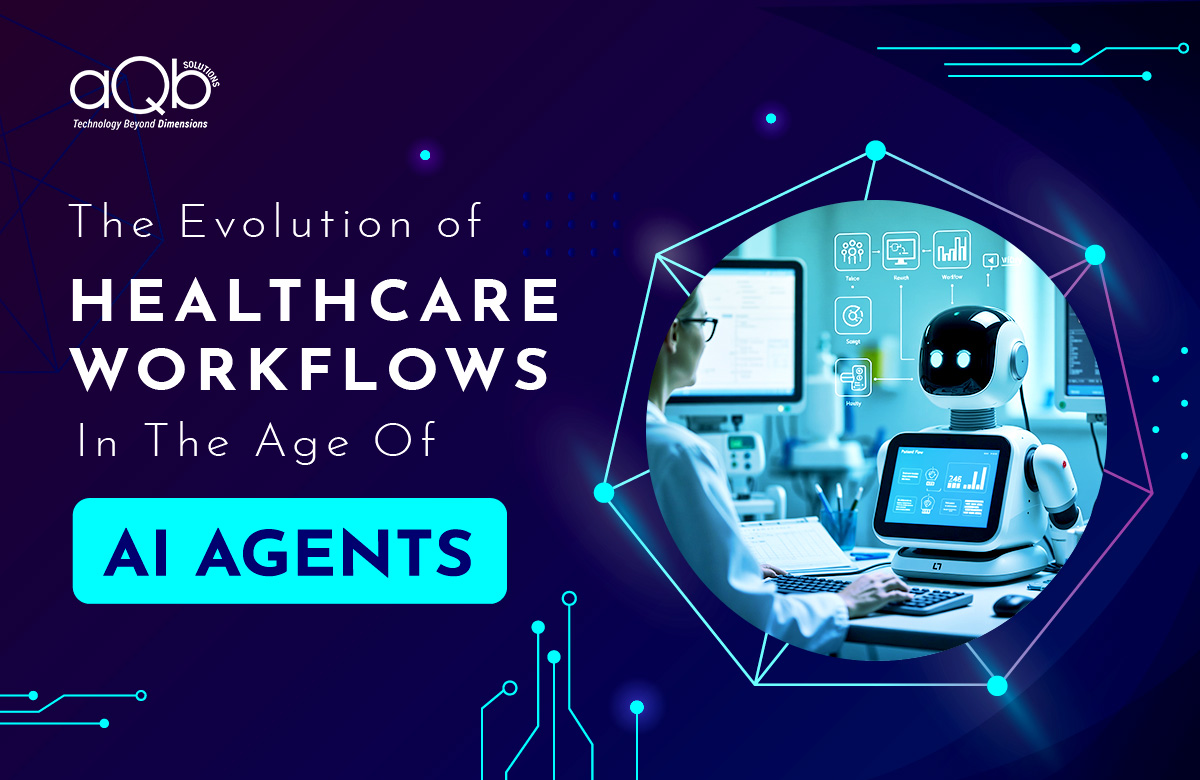
Healthcare systems across the world are under unprecedented pressure. Rising patient volumes, clinician burnout, complex regulatory demands, fragmented data, and the growing need for personalised care are stretching traditional workflows to their limits. While digital tools have long promised efficiency, many have acted merely as passive assistants, supporting tasks but still heavily reliant on human direction.
AI agents are changing that equation.
Unlike conventional automation or rule-based software, AI agents can perceive, decide, learn, and act autonomously within defined boundaries. In healthcare, this marks a fundamental shift: from tools that assist humans to intelligent partners that actively participate in clinical, operational, and administrative workflows.
This evolution is not futuristic speculation, it is already reshaping how care is delivered, managed, and scaled.
What Are the Benefits of Agentic AI in Healthcare?
AI agents bring a unique combination of intelligence, adaptability, and autonomy that delivers value across the healthcare ecosystem.
1. Reduced Administrative Burden
Healthcare professionals spend a significant portion of their time on documentation, scheduling, data entry, and compliance reporting. Agentic AI in healthcare can autonomously manage these tasks – updating electronic health records (EHRs), coordinating appointments, validating insurance information, and ensuring regulatory compliance—freeing human staff to focus on patient care.
2. Improved Decision Support
AI agents continuously analyse large volumes of clinical, operational, and real-world data. By identifying patterns that may be invisible to humans, agentic AI in healthcare can provide timely insights, flag risks, and recommend next steps—supporting faster, more informed decision-making without replacing clinical judgement.
3. Scalable and Consistent Operations
Unlike human teams, AI agents operate continuously without fatigue. They apply protocols consistently across departments, locations, and time zones, helping healthcare organisations scale services while maintaining quality and safety standards.
4. Proactive Rather Than Reactive Care
By monitoring patient data in real time, AI agents can anticipate deterioration, non-adherence, or complications before they escalate. This shift towards proactive care improves outcomes while reducing avoidable hospital admissions.
How Have AI Agents Helped the Medical Field?
AI agents have helped the medical field by transforming how clinical, operational, and research activities are carried out. They support faster and more accurate diagnosis by analysing medical images, pathology slides, and patient records at a scale that would be difficult for humans alone.
In clinical practice, AI agents automate routine tasks such as documentation, appointment coordination, and follow-ups, reducing administrative burden and allowing healthcare professionals to spend more time with patients. They have also strengthened clinical research by improving patient recruitment, monitoring trial protocols, and ensuring data quality in real time.
Beyond direct care, AI agents optimise hospital operations by forecasting demand, managing resources, and improving patient flow. Through continuous learning and real-time data analysis, AI agents enable more proactive, efficient, and consistent healthcare delivery, ultimately improving outcomes while easing pressure on healthcare systems.
What are the Key Applications and Benefits of AI Agents and IoT in Healthcare?
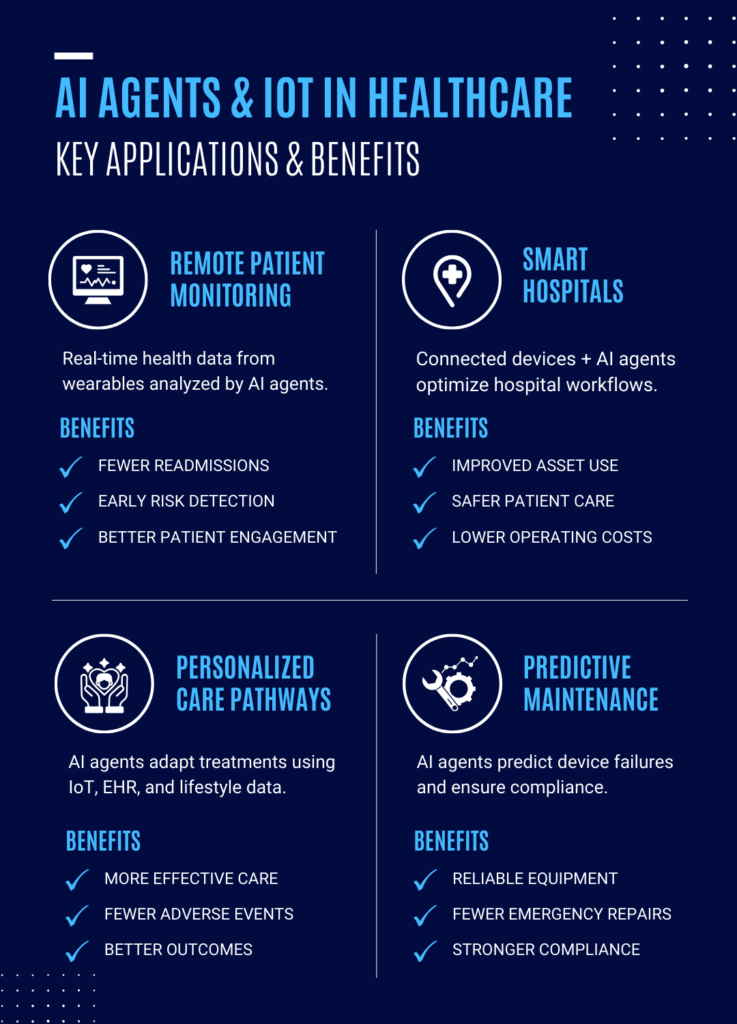
The convergence of AI agents and the Internet of Things (IoT) unlocks powerful new capabilities across the continuum of care.
Remote Patient Monitoring
IoT devices – such as wearables, smart implants, and home sensors – continuously collect vital signs and behavioral data. AI agents interpret these signals in real time, detecting anomalies, predicting deterioration, and triggering timely interventions without manual oversight.
Benefits:
- Reduced hospital readmissions
- Early detection of chronic disease flare-ups
- Improved patient engagement and adherence
Smart Hospitals and Connected Infrastructure
Within hospitals, IoT devices track equipment, environmental conditions, and patient movement. AI agents orchestrate this data to optimize workflows, ensuring the right resources are available at the right time.
Benefits:
- Better asset utilization
- Enhanced patient safety
- Lower operational costs
Personalised Treatment Pathways
By combining IoT data with EHRs, genomics, and lifestyle information, AI agents help tailor treatment plans to individual patients. These plans evolve dynamically as patient responses change.
Benefits:
- More effective therapies
- Fewer adverse events
- Improved long-term outcomes
Predictive Maintenance and Risk Management
AI agents monitor connected medical devices to predict failures before they occur. This reduces downtime, enhances patient safety, and supports regulatory compliance.
Benefits:
- Increased equipment reliability
- Reduced emergency repairs
- Better compliance reporting
What are some Agentic AI Healthcare Use Cases?
Here are some noteworthy use cases of agentic AI in healthcare:
Autonomous clinical decision support and diagnostic agents: These systems analyse complex clinical data such as electronic health records, imaging scans, and lab results to highlight patterns, suggest diagnoses, and recommend personalised treatment options, helping clinicians make faster, evidence-based decisions.
Autonomous patient monitoring and care coordination: AI agents continuously track vital signs and behavioural data from wearables and sensors, detect early signs of deterioration, adjust care plans in real time, and notify care teams as needed, improving chronic disease management and reducing hospital readmissions.
Hospital operations: Here, agentic AI optimises bed allocation, staff scheduling, and equipment use based on demand forecasting, boosting efficiency and reducing bottlenecks. Administrative workflows also benefit – AI agents can autonomously handle appointment triage, medical coding, billing, and insurance preauthorisations, easing administrative burden and accelerating revenue cycles.
Agentic AI in Healthcare: From Tools to Trusted Partners
The defining characteristic of agentic AI in healthcare is not automation alone, it is autonomy with accountability. When designed responsibly, governed transparently, and integrated thoughtfully, AI agents do not replace clinicians or administrators. They augment human expertise, handle complexity at scale, and enable healthcare systems to function more intelligently.
As healthcare continues its shift towards value-based care, decentralised delivery models, and personalised medicine, AI agents will play an increasingly central role. They represent a move away from fragmented, reactive workflows towards connected, proactive, and resilient systems.
The future of healthcare is not human or machine, it is human with intelligent, autonomous partners working quietly in the background, ensuring care is safer, smarter, and more sustainable for all.