Retail has always aspired to treat every customer like a “regular.”
The shop owner who knew your name, your preferences, and what you were likely to buy next created loyalty without dashboards or data models.
Today, retailers serve millions of customers across websites, apps, marketplaces, and physical stores. The expectation of personalization hasn’t gone away—it has intensified. Shoppers now expect brands to understand them instantly, across channels, in real time.
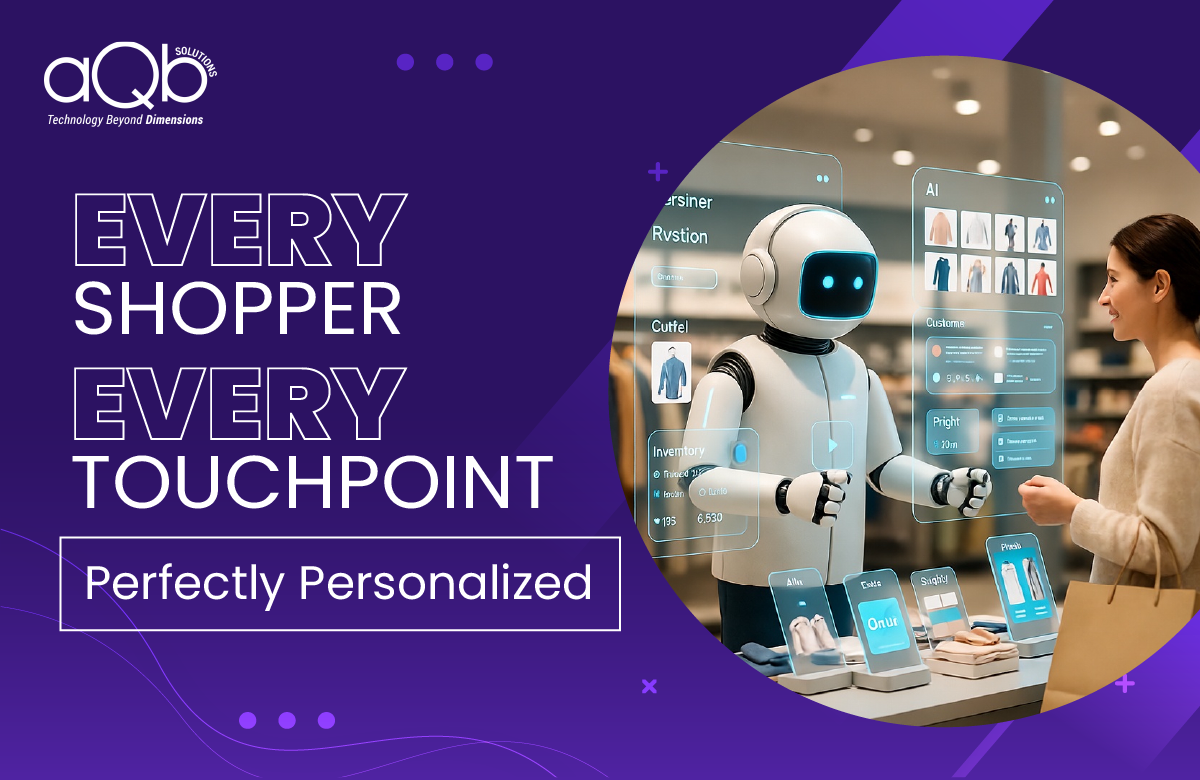
This is where AI agents are redefining what retail personalization looks like—and making true 1:1 shopping experiences possible at scale.
Why Traditional Personalization Falls Short
Most retail personalization today is still rule-based or segment-driven:
- “Customers who bought X also bought Y”
- Static segments like “price-sensitive,” “loyal,” or “new users”
- Campaigns built weeks in advance
While useful, these approaches struggle with modern retail realities:
- Customer behavior changes rapidly
- Journeys span multiple touchpoints
- Context (time, intent, inventory, channel) matters
The result? Recommendations that feel generic, emails that arrive too late, and offers that miss the mark.
Enter AI Agents: A New Layer of Intelligence
AI agents are autonomous, goal-driven systems that observe, reason, and act continuously. Unlike traditional models that respond to single triggers, agents operate across workflows and channels with memory and context.
In retail personalization, AI agents don’t just predict—they orchestrate.
They can:
- Track individual customer behavior across sessions and channels
- Learn preferences over time
- Adapt recommendations dynamically
- Take actions (not just generate insights)
This shift—from insight generation to autonomous execution—is what unlocks personalization at scale.
How do AI agents for ecommerce work?
- Ingest data from ecommerce platforms, CRMs, inventory systems, and customer interactions
- Analyze signals such as browsing behavior, purchase history, demand patterns, and support queries
- Make decisions using predefined goals, rules, and AI-driven reasoning models
- Trigger actions like updating prices, launching campaigns, routing tickets, or flagging exceptions
- Orchestrate workflows across tools using automation platforms like n8n
- Learn continuously by monitoring outcomes and adjusting decisions over time
This enables ecommerce operations to run faster, smarter, and with minimal manual intervention.
What are the benefits of AI Agents in e-commerce?
So, what 1:1 personalization looks like with AI agents?
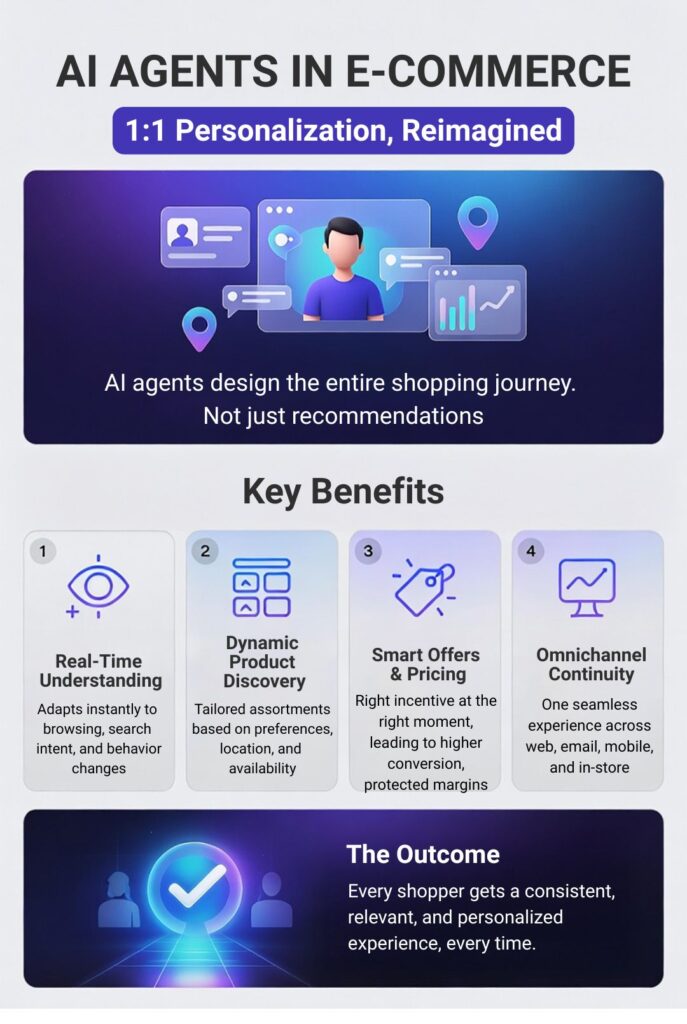
With AI agents in place, personalization moves beyond product recommendations into full journey design.
1. Real-Time Behavioral Understanding
AI agents continuously analyze signals such as:
- Browsing patterns
- Search intent
- Purchase history
- Time spent, frequency, and drop-offs
Instead of waiting for batch updates, agents adjust experiences in real time—changing product rankings, banners, and messaging as intent evolves.
2. Dynamic Product Discovery
Rather than showing the same “top sellers” to everyone, agents curate product assortments unique to each shopper:
- Highlighting preferred styles, brands, or price ranges
- Factoring in availability, location, and delivery timelines
- Learning from micro-interactions, not just purchases
Every storefront becomes personal.
3. Personalized Offers and Pricing Logic
AI agents can determine when and how to present offers:
- Avoiding unnecessary discounts for high-intent buyers
- Triggering incentives when hesitation is detected
- Tailoring promotions based on lifetime value and loyalty
This protects margins while improving conversion.
4. Omnichannel Continuity
A shopper who browses on mobile, abandons on desktop, and walks into a store shouldn’t feel like three different customers.
AI agents maintain memory across touchpoints:
- Syncing online browsing with email, push, and in-store experiences
- Ensuring recommendations and messaging stay consisten
- Adapting tone and format to the channel, without losing context
Beyond Marketing: Agents Across the Retail Stack
AI-driven personalization doesn’t stop at the front end.
- Customer Support Agents anticipate issues, surface relevant help, or proactively resolve concerns based on customer history.
- Inventory-Aware Agents personalize recommendations based on real-time stock and local availability.
- Post-Purchase Agents tailor reorder reminders, care tips, and cross-sell suggestions based on usage patterns.
Personalization becomes an ecosystem, not a campaign.
Trust, Transparency, and Responsible Personalization
With great personalization comes great responsibility.
Retailers must ensure:
- Data privacy and consent management
- Explainable decision-making
- Guardrails against bias or over-targeting
Well-designed AI agents include governance layers that align actions with compliance, brand values, and customer trust.
The Future of Retail Is Personal – and Autonomous
As customer expectations rise, static personalization will no longer be enough. Shoppers don’t want to be part of a segment, they want to be understood as individuals.
AI agents make that possible by:
- Learning continuously
- Acting autonomously
- Scaling human-like intuition across millions of customers
The retailers that win won’t be the ones with the most data—but the ones with the smartest agents turning that data into meaningful, personal experiences. In the age of AI agents, personalization isn’t a feature. It’s the foundation of modern retail.