For leaders in financial services, it feels like déjà vu all over again. Just when many thought they’d nailed a robust enterprise AI strategy and were poised to push ahead, along comes the next big wave: agentic AI. Staying ahead means keeping a close eye on the innovation cycle and turning these disruptions into genuine opportunities.
Agentic AI is already starting to reshape how banks and fintechs work, moving quickly from theory to practical applications. Deloitte forecasts that by 2027, half of companies using generative AI will have deployed agentic systems – up from 25% seen this year. Institutions are actively exploring ways to harness this technology to boost teams, delight customers, reward shareholders, manage risks, and fuel sustainable growth.
Leaders and decision-makers in the financial sector, who are still thinking whether they should hop on to the AI agent bandwagon, may find themselves asking these questions.
#1. Can AI Agents Improve Accuracy and Efficiency in Financial Tasks?
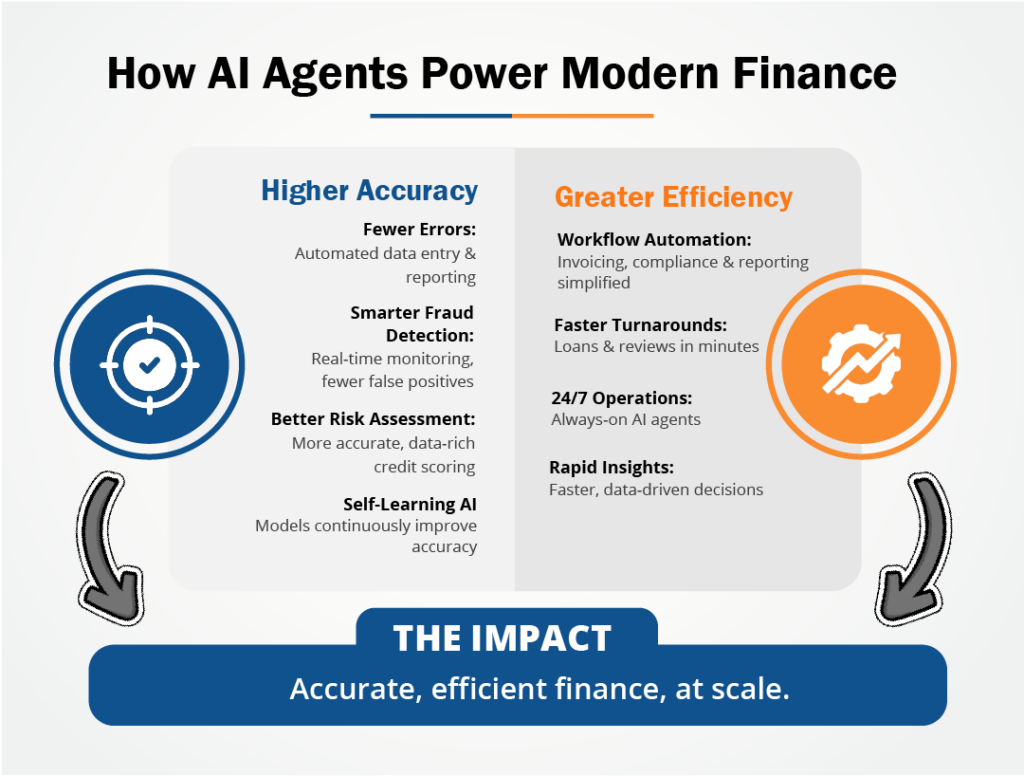
Yes, AI agents dramatically boost accuracy as well as efficiency in financial tasks. The use of agentic AI in finance industry automates data-heavy processes, lowering human error and enabling real-time analysis. Acting as autonomous systems that learn and adapt, they transform how financial organizations work.
How AI agents enhance accuracy
- Minimizing human errors: By automating repetitive tasks such as data entry, reconciliation, and reporting, AI agents significantly reduce manual mistakes that can be costly in financial operations.
- Advanced fraud detection: AI agents analyze vast volumes of transaction data in real time, identifying unusual patterns more effectively than traditional systems and reducing false positives by up to 60%.
- Improved risk assessment and credit scoring: By leveraging both traditional and alternative data sources, AI agents deliver more accurate risk profiles, helping institutions reduce defaults.
- Continuous learning: Machine learning enables AI agents to refine models continuously, improving prediction accuracy over time.
How AI agents drive efficiency
- Workflow automation: AI agents streamline processes like invoice handling, compliance checks, and regulatory reporting.
- Faster turnaround times: Tasks such as loan underwriting or document reviews are completed in minutes instead of weeks.
- 24/7 availability: Always-on AI agents ensure uninterrupted customer support and operational continuity.
- Rapid data analysis: AI agents process structured and unstructured data at scale, enabling faster, better-informed decisions across AI for financial services.
#2. How are AI Agents Transforming Finance and Accounting Industries?
AI agents are rapidly reshaping the finance and accounting industries, shifting the emphasis from manual, repetitive work to autonomous, data-driven decision-making and strategic analysis. When it comes to AI in banking and finance, these agents function as intelligent, self-directed systems that learn continuously from data, adapt to changing conditions, and execute complex, end-to-end workflows with minimal human intervention. The use of AI in finance is no longer experimental, it’s becoming foundational.
How AI agents are driving change
- Real-time intelligence: Continuous data analysis enables faster forecasting, planning, and scenario modelling.
- Proactive risk control: Always-on monitoring strengthens compliance and fraud detection.
- Faster financial close: Automated reporting shortens cycles and improves transparency.
Enhanced client engagement: Conversational AI delivers instant, personalised financial support.
Key areas of transformation
| Function | AI Agent Role | Impact on Industry |
| Automation of Processes | Automates data entry, invoice processing, and reconciliations | Higher efficiency, fewer errors, lower costs |
| Financial Planning & Analysis | Real-time forecasting, scenario modelling, and budget tracking | Faster, more accurate, proactive decisions |
| Risk Management & Compliance | Monitors transactions and regulations (AML, SOX) | Stronger controls, reduced regulatory risk |
| Auditing & Reporting | Automates data validation and report generation | Faster close, transparent audit trails |
| Customer Service & Advisory | Delivers instant, personalised financial guidance | Improved CX, focus on high-value advisory |
Together, AI agents are redefining productivity, resilience, and strategic value across modern finance functions.
#3. What should Companies Consider when Implementing AI Agents in Finance?
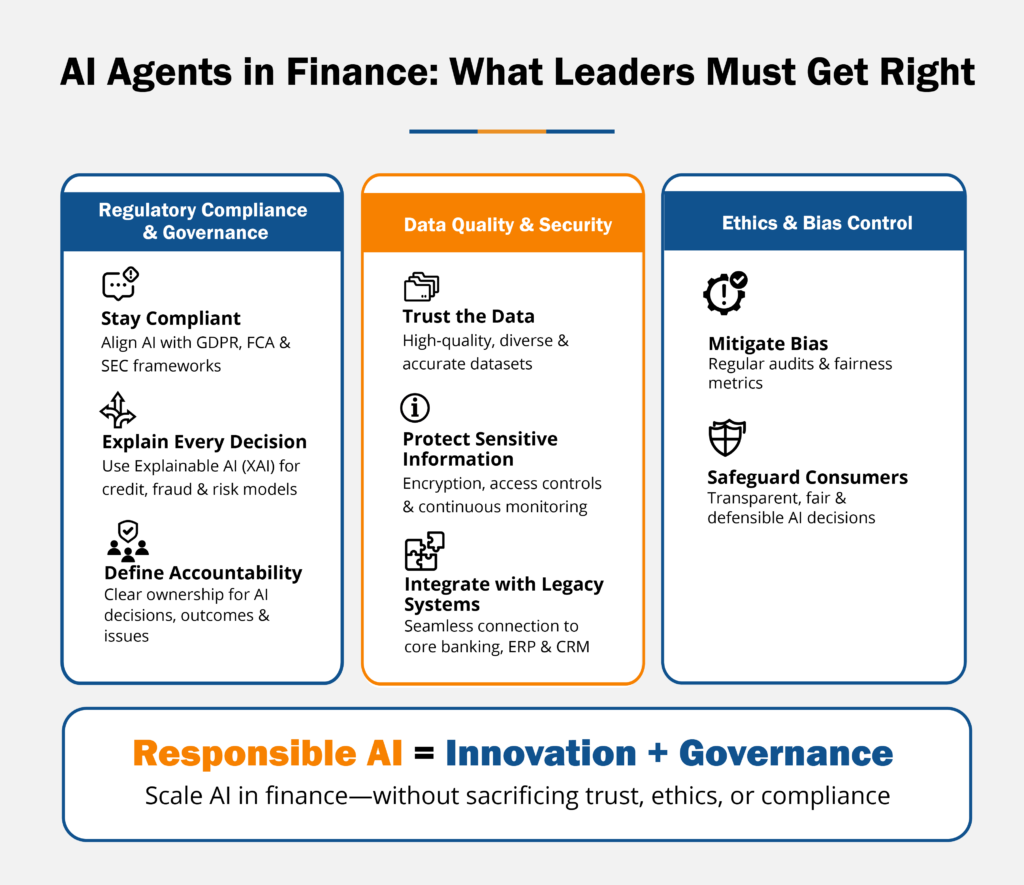
When implementing AI agents in finance, organisations must adopt a multi-faceted approach that balances innovation with strong oversight. Below are the key considerations business leaders should address to ensure responsible and scalable adoption of artificial intelligence in fintech.
Regulatory compliance and governance
- Adherence to Regulations: AI agents must comply with evolving legal frameworks such as the EU’s GDPR, the UK’s FCA guidelines, and US SEC regulations. This requires aligning AI initiatives with existing governance, risk, and audit processes.
- Transparency and Explainability (XAI): In high-stakes use cases like credit scoring, fraud detection, and risk assessment, regulators and customers expect clear explanations. Explainable AI in financial decision making is essential to avoid “black box” decision-making.
- Accountability: Clear ownership models must define who is responsible for AI-driven decisions, outcomes, and remediation when issues arise – an essential pillar of AI governance in financial services.
Data quality and security
- Data Quality and Availability: AI agents rely on accurate, complete, and representative data. Strong data governance frameworks help prevent bias, errors, and unreliable outputs.
- Data Privacy and Security: Financial data is highly sensitive. Organizations must implement encryption (at rest and in transit), strict access controls, and continuous monitoring to meet privacy and security standards.
- Legacy System Integration: Seamless integration with existing ERPs, CRMs, and core banking systems is critical for operational continuity and ROI.
Ethical considerations and bias
- Fairness and Bias Mitigation: Historical data can embed bias. Regular audits, fairness metrics, and independent reviews are necessary to ensure equitable outcomes.
- Consumer Protection: AI-driven decisions must be transparent, justifiable, and aligned with ethical standards to maintain trust and avoid reputational risk.
A structured approach ensures AI agents deliver value while maintaining trust, compliance, and long-term resilience.
#4. How are Roles Evolving in Finance with Agentic AI?
As agentic AI steps up, making smart, independent decisions and learning from fresh data, it’s reshaping the finance world. Gone are the days of endless data entry, tedious reconciliations, and routine customer queries—these are now handled by AI. But this isn’t about job losses; it’s about exciting new hybrid roles that blend human smarts with tech power. Let’s explore how careers are transforming.
Emerging hybrid job roles
Picture this: finance pros teaming up with AI to tackle bigger challenges. Here are some key roles on the rise:
- AI Auditors and Compliance Specialists: These experts act as watchdogs, making sure AI systems play fair, stay unbiased, and keep up with ever-changing financial rules. It’s all about trust and accountability in an automated age.
- AI-Enhanced Investment Analysts and Portfolio Managers: No more drowning in data alone. These specialists harness AI to crunch massive market info and economic signals, delivering sharper insights and smarter strategies that outpace what AI could do solo.
- AI Systems Integrators: Think of them as the glue holding everything together. They ensure AI agents chat seamlessly and fit snugly into old-school systems, avoiding tech hiccups.
- Client Relationship Managers and Financial Advisors: In a world of algorithms, the human touch shines. These roles zero in on empathy, building personal connections and offering tailored advice where emotional intelligence makes the difference.
- AI Trainers and Governance Specialists: Like coaches for machines, they monitor AI performance, tweak it with feedback, and set ethical guidelines to keep things on the right track.
These shifts mean finance jobs are evolving into more strategic, creative positions, where humans add the nuance AI can’t quite capture.
#5. What are Some Real-World Examples of Agentic AI in Finance?
Agentic AI isn’t lurking in some distant future, it’s already revamping how finance works today. These autonomous systems don’t just suggest; they decide and act, tackling everything from compliance headaches to investment twists. Let’s explore a couple of trailblazers showing real impact, plus why this tech is a game-changer.
Silent Eight: Revolutionizing AML Compliance
Picture this: compliance alerts piling up, but AI steps in to sort 80% of them without a human glance. Silent Eight’s self-learning agents do exactly that, slashing false positives through constant self-improvement and sharper decisions. In 2025, the platform notched key milestones, like regulatory approval for auto-closing alerts with explainable outputs, making it a go-to for banks worldwide. This not only cuts manual drudgery but speeds up high-risk probes, boosting efficiency and regulatory trust in a scalable way.
InsiderFinance: Mastering Real-Time Investments
Tired of static portfolio advice? InsiderFinance flips the script with AI agents that scan user sentiment, market swings, and global trends nonstop, rolling out personalized strategy updates every hour. Tailored to your risk appetite, it empowers smarter choices amid volatility. By 2025, advancements in autonomous trading have pushed returns sky-high—think over 200% annualized in spots—with win rates hitting 65-75%. It’s like having a vigilant financial co-pilot that adapts on the fly.
Why Agentic AI Matters Now
These examples prove agentic AI delivers tangible wins: cost cuts, faster ops, and fresh innovations for customers and firms alike. But success hinges on smart rollout and ethical guardrails. In a fast-shifting landscape, embracing it thoughtfully keeps you competitive – ignore it, and you risk falling behind.